
Trust should be built into every part of the journey.
Mind Journey is designed around thoughtful data use, permission- based access, responsible AI, human oversight, and clear clinical and safety boundaries—so psychological information can support understanding without losing sight of the person behind it.

TRUST PRINCIPLES
What trust means in Mind
Journey.
Trust is not one feature. It comes from how information, permissions, technology,
professional responsibility, and boundaries work together throughout the
experience.
Privacy
Sensitive information deserves careful handling.
Psychological information should be treated with care and used for clear purposes.
Transparency
You should understand how information is used.
Important uses of personal information should be understandable rather than hidden behind technical or legal language.
Consent
Permission should be meaningful.
Where consent is relevant, people should understand what they are agreeing to and why.
Controlled Access
Not everyone should see the same information.
Access should reflect purpose, role, permission, and appropriate consent.
Responsible AI
AI should support understanding—not become the authority.
AI can assist the process, while human judgment remains essential where decisions require professional responsibility.
Human Oversight
Important decisions need human responsibility.
Automation should support people without removing accountability from decisions that require judgment.
Safety & Boundaries
Trust includes knowing what the system cannot do.
Clear limitations are part of responsible psychological technology.
Psychological information deserves thoughtful protection.
Mind Journey is designed around a simple principle: sensitive information should have a clear purpose, understandable boundaries, and appropriate controls.
Purpose
Information should have a reason to be there.
Psychological information should be collected and used for defined purposes relevant to the experience.
Relevance
More information is not automatically better.
Information should be relevant to the purpose it is intended to serve.
Transparency
You should be able to understand what is happening.
Important information practices should be explained in language people can understand.
Control
Your available choices should be visible.
Where controls apply, people should be able to understand the choices available to them.
CONSENT & CHOICE
Consent should be
understandable—not buried in
fine print.
When consent is relevant, people should be able to understand what they are agreeing to, why it matters, who may be involved, and what the information may be used for.
What
What information is involved?
Why
Why is it needed?
Who
Who may appropriately access it?
How
How may it be used?
Choice
What choices are available?
Consent is not the same as account creation.
Not everyone should see the same information.
Access should follow purpose, role, permission, and appropriate
consent. Having an account or an administrative role does not
automatically create access to sensitive psychological
information.
Administrative access does not automatically mean access to individual psychological information.
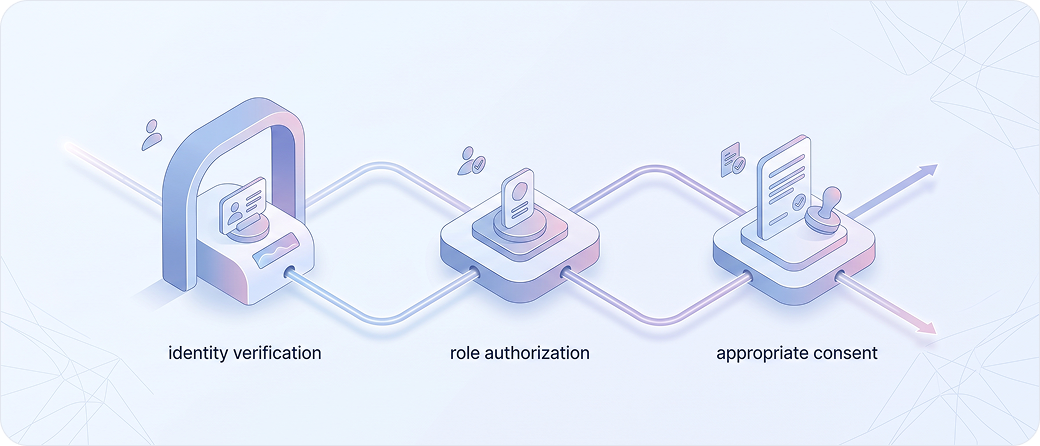
Authentication
Who are you?
Authentication establishes identity.
Authorization
What are you allowed to do?
Authorization defines what a role is permitted to access or manage.
Consent
What information may appropriately be shared?
Consent adds another important boundary where it applies.
These are related—but they are not the same thing.
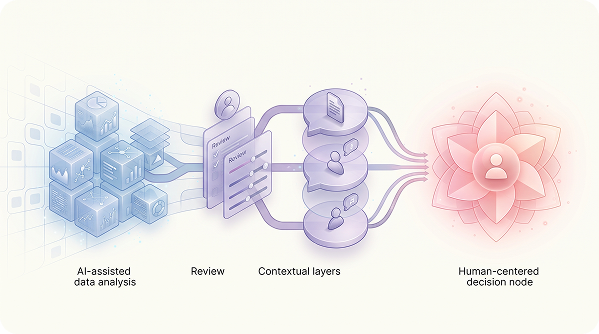
AI should support understanding—not claim authority.
Mind Journey approaches AI as a supporting layer for understanding. AI should operate within defined purposes and limitations, while human judgment remains essential where interpretation or decisions require professional responsibility.
AI supports understanding. Human judgement guides decisions.
Automation should not erase accountability
Mind Journey should know what it is—and what it is not.
Mind Journey is designed to support understanding, contextual insight, reflection, longitudinal perspective, and professional decision support where appropriate. These forms of support should not be confused with autonomous diagnosis or treatment.
Understanding
Support information in becoming more meaningful in context.
Reflection
Help create space for structured reflection and perspective.
Longitudal Perspective
Help connect relevant information across time rather than reducing a journey to a single moment.
Professional Decision Support
Support qualified professionals with relevant information where appropriate.
An automatic diagnosis service
Autonomous psychological treatment
An emergency service
A replacement for qualified professionals
A system that guarantees outcomes
Safety
Safety requires clear processes—
not just warnings.
Psychological technology needs clear limits around safety. People should
understand what the system can support, where its limitations begin, and when
human responsibility becomes essential.
Clear Limitations
Safety begins with knowing the limits of the system.
Human responsibility
High-stakes situations require human responsibility. Automated systems should not become the sole basis for high-risk decisions.
Defined Processes
Safety processes should be explicit before they are promised. Capabilities related to safety signals, escalation, or crisis response should only be described when they are defined, validated, and operational.
and limitation.
A trustworthy system should be able to say when it does not know enough.
Psychological understanding is shaped by context, information quality, and uncertainty. Technology should not turn incomplete information into false certainty.

Limited Information
Incomplete information should remain incomplete—notbecome a confident conclusion.
Uncertainty
Confidence should not be overstated. Where uncertainty matters, it should remain visible.
AI Disclosure
People should know when AI contributes. AI involvement should be understandable in the parts of the experience where it is relevant.
Reviewability
Important outputs should support appropriate review. Where professional responsibility applies, relevant outputs should not be treated as beyond question.
Explore the Details
Go deeper into the parts of trust
that matter to you.
Trust questions are different for every person and every context. Explore the principles,
boundaries, and responsibilities behind Mind Journey in more detail.
Privacy & Data
Understand how Mind Journey approaches sensitive information, permissions, access, and data boundaries.
Responsible AI
Learn how AI is intended to support understanding while remaining within clear purposes, limitations, and human oversight.
For Professionals
Explore how professional judgement, review, and responsibility fit into the Mind Journey experience.
For Organizations
Explore governance, administrative roles, and information boundaries in organizational contexts.
Understand Before You Decide
Trust starts with understanding
how the system works.
Explore how Mind Journey approaches sensitive information, responsible AI, human
judgment, and the boundaries that shape a more responsible experience.